Very good new CNN article by Julia Horowitz on “Job guarantees and free money: ‘Utopian’ ideas tested in Europe as the pandemic gives governments a new role”.
It discusses the recent interest in the Universal Basic Incomes (UBI) and what economic and political factors are driving it.
As this partly touches on research I have been doing on support for UBI across Europe, I had the pleasure of discussing the challenges of a pro-UBI coalition with Julia.
Indeed, as I show in my recent articles, the coalition supporting the idea of a UBI is very heterogenous and it has been shown elsewhere that support also depends on the framing of the question.
Question in the European Social Survey
The 2016 wave of the ESS (ESS,2016) includes a question about the university basic income (UBI). Respondents are asked whether they are “against or in favour of the UBI scheme” being introduced in their respective country, which “some countries are currently talking about”, with the following characteristics:
1. The government pays everyone a monthly income to cover essential living costs;
2. It replaces many other social benefits;
3. The purpose is to guarantee everyone a minimum standard of living;
4. Everyone receives the same amount regardless of whether or not they are working;
5. People also keep the money they earn from work or other sources;
6. This scheme is paid for by taxes.
Support for the Universal Basic Income across countries
I focus on 21 countries in my analysis: Austria, Belgium, Czech Republic, Estonia, Finland, France, Germany, Hungary, Iceland, Ireland, Italy, Lithuania, Netherlands, Norway, Poland, Portugal, Slovenia, Spain, Sweden, Switzerland, and the United Kingdom.
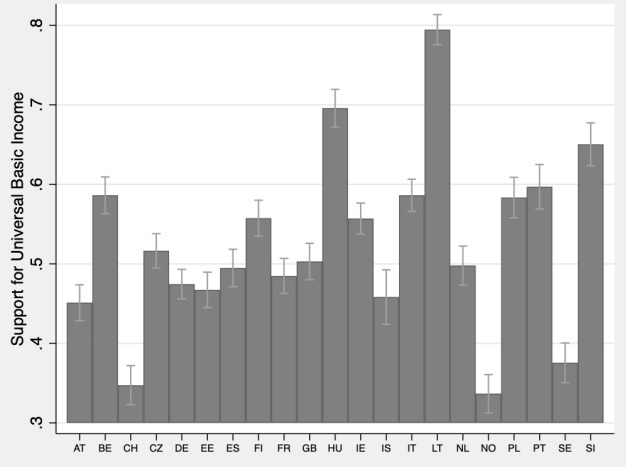
Adding those who are “in favour” or “strongly in favour” of the scheme indicates that a slight majority (51.2%) support a UBI.
The cross-national variation can be observed below (with the bars indicating the uncertainty around the estimated country average). Support tends to be higher in South and Central Eastern Europe, and lower in Scandinavian countries.
Who supports UBI?
My findings are partly consistent with what we know about the drivers of support for other social policies. Younger, low-income, left-leaning individuals and the unemployed are more likely to support a UBI.
Individuals with positive views of benefit recipients and/or high trust in political institutions are also more supportive, while anti-immigration attitudes are associated with lower support.
Trade union membership is not always relevant, perhaps because of contradictory effects: unions typically support new welfare state policies but they also have a key role in many existing welfare state schemes and may worry about individuals’ attachment to the labour market.
Cross-national variation
At the cross-national level, support tends to be higher where unemployment benefit activation is more pronounced and unemployment benefits less generous.
This suggests that countries where welfare state institutions are less developed might be better placed to introduce a UBI.
The paradox of high support
Overall these findings suggest one possible reason why countries with high support for a UBI have not introduced it: the mixed support among the left means a pro-UBI coalition has to draw on right-wing voters who may support it only with lower taxes and/or extensive replacement of welfare state benefits, which in turn may further alienate parts of the left.
In other words, the fact that a UBI can mean different things to different people may explain both the fairly high support for the scheme in some countries and the difficulty in finding a politically viable coalition to support its introduction when the financing of a UBI and its interaction with existing welfare state benefits have to be specified.
Thus, the wide political appeal of the UBI might also be its greatest weakness: because many people support a UBI for very different reasons, the basis of support are politically and ideologically fragmented and may therefore be irreconcilable.
Details about European Social Survey
Reference:
European Social Survey (2017). ESS Round 8 (2016/2017) Technical Report. London: ESS ERIC
Excerpt from ESS website:
“The European Social Survey (ESS) is an academically-driven multi-country survey, which has been administered in over 30 countries to date. Its three aims are, firstly – to monitor and interpret changing public attitudes and values within Europe and to investigate how they interact with Europe’s changing institutions, secondly – to advance and consolidate improved methods of cross-national survey measurement in Europe and beyond, and thirdly – to develop a series of European social indicators, including attitudinal indicators. In the eighth round, the survey covers 23 countries and employs the most rigorous methodologies. From Round 7 it is funded by the Members, Observers and Guests of ESS European Research Infrastructure Consortium (ESS ERIC) who represent national governments. Participating countries directly fund the central coordination costs of the ESS ERIC, as well the costs of fieldwork and national coordination in their own country. The survey involves strict random probability sampling, a minimum target response rate of 70% and rigorous translation protocols. The hour-long face-to-face interview includes questions on a variety of core topics repeated from previous rounds of the survey and also two modules developed for Round 8 covering Public Attitudes to Climate Change, Energy Security, and Energy Preferences and Welfare Attitudes in a Changing Europe (the latter is a partial repeat of a module from Round 4).”
References
Vlandas, T. (2020) “The Political Economy of individual level support for the basic income in Europe” Journal of European Social Policy [PDF]
Vlandas, T. (2019) “The Politics of the Basic Income Guarantee: Analysing individual support in Europe” Basic Income Studies [PDF]
 Tim Vlandas
You must be logged in to post a comment.